Fully funded PhD position on MINDAI
A four-year, fully funded PhD position at the Universitat de Barcelona, on multimodal single-cell modelling with deep generative models, within the MINDAI project.
Last updated 28 August 2026
This is a pre-announcement. The formal call has not been published yet, so every date below is an expectation based on previous years, not a confirmed date. Confirmed dates will be posted here as soon as the official call is out. The selection is open and competitive: nobody has been pre-selected, and nothing here commits the university or the project to any outcome.
the project
MINDAI — Multimodal Integration for Neuroscience Discovery using Artificial Intelligence — is funded by the Spanish Ministry of Science under Proyectos de Generación de Conocimiento 2025, and runs from 2026 to 2030. It aims at the most complete multimodal single-cell atlas of the mouse cortex built so far, and at releasing it as something other labs can actually use rather than as a figure in a paper.
the data
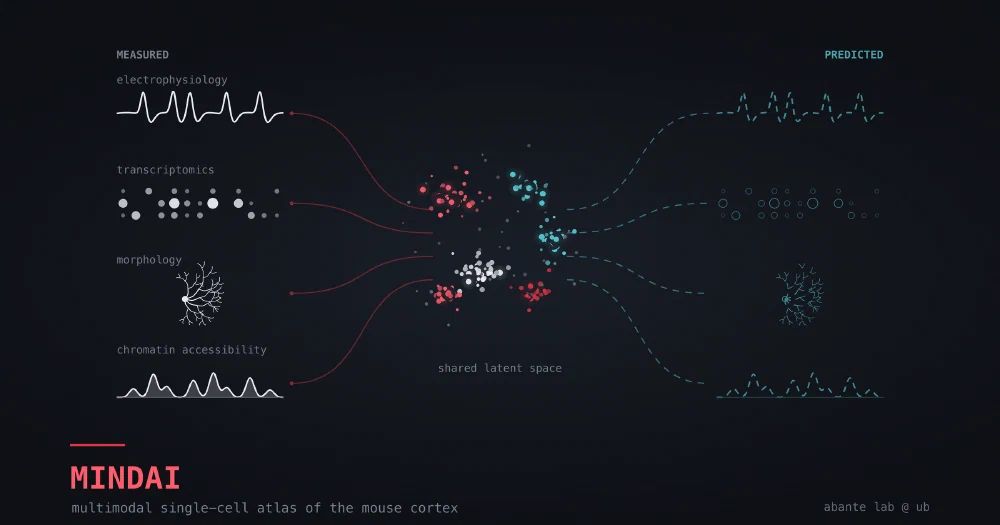
Patch-seq measures three things in the same individual neuron: its transcriptome, its electrophysiology and its morphology. It is laborious and technically demanding, which means the public Patch-seq datasets that exist represent an enormous amount of work — and they sit in separate repositories, produced under different protocols, largely unintegrated. MINDAI is built mainly on those public cortical datasets, with a fourth modality, chromatin accessibility, added from single-cell epigenomic data.
No public resource currently integrates these four modalities across multiple cortical regions. The Allen Brain Institute’s atlases come closest and cover fewer modalities, with no framework for integrating them, for projecting external data into them, or for perturbing them in silico. Given what Patch-seq costs to generate, getting more out of the data that already exists is worth doing on its own terms.
the modelling
The four modalities measure the same cell on entirely different scales, with different noise, and the relationships between them are nowhere near linear. The approach is deep generative models: learn a shared latent representation that accounts for how each observed modality could have been produced from a common underlying cell state, rather than merely projecting everything into the same picture. Inference is variational, which is what keeps it scalable and, more to the point, keeps a handle on uncertainty — the data are sparse, biased and noisy, and a model that cannot say how confident it is will mislead the biologist reading it.
The capability this is all for is domain translation: given a cell observed in one modality, predict the others. Electrophysiology from the transcriptome, morphology from chromatin state, and so on. That only works if the latent space captures what the modalities genuinely share instead of memorising each one separately, which is what makes it a modelling problem rather than an engineering one. Interpretability matters for the same reason — a representation is only useful here if you can ask it why, which is where explainability methods come in.
what it produces
The project ends with the atlas released behind an API, so a researcher outside the project can project their own cells into the shared representation, have missing modalities filled in, and run virtual perturbations. The scientific point of that is to connect gene regulation to neuronal activity and brain function, and to give people a way to look for molecular signatures tied to behaviour and to disease.
There is a second audience for the work. Integrating high-dimensional, multimodal single-cell data pushes on model design, scalability and interpretability in ways that are not specific to neurons, so the methods should carry to other domains — and that half of the contribution is a machine learning contribution, publishable as such.
The PhD student works in the methodological core: the shared representation and the translation between modalities, and then what that representation says about how the cortex is organised.
what the position includes
- A four-year, full-time predoctoral contract. Salary is set by the FPI call
- An additional allowance for doctoral fees and research stays
- A planned three-month research stay
- Training through the UB Doctoral School, UBNeuro and IDIBAPS
- A young group with strong international collaborations — Stanford, UC Santa Cruz, King’s College London, among others — public datasets, and computational resources including access to the Barcelona Supercomputing Center
who we are looking for
You might come from computational biology, computer science, physics, mathematics, biomedical engineering or something adjacent — we are not prescriptive about the degree on the certificate.
What matters is a strong background in machine learning and AI, including modern architectures such as transformers, and being comfortable with Python and the usual machine learning frameworks. Beyond that, we are looking for someone interested in both sides of the problem: the modelling and the biology. Single-cell experience is a plus, not a requirement — the biology can be learned on the way. Working English is enough; Catalan and Spanish are not needed.
If you are unsure whether you fit, write anyway.
how the process works
- The formal call is published by the Universitat de Barcelona — Secció de Beques de Personal Investigador en Formació — on the UB Seu Electrònica and on the FPI grants page.
- Candidates apply themselves, through the UB’s GAIA/CAIAC platform, selecting one project — this one. Writing to me is not an application and does not replace it.
- You must not already hold a PhD. That is the requirement people most often ask about. The doctorate itself is done in the Biomedicine programme at the UB Faculty of Medicine and Health Sciences, which has its own admission and enrolment procedure.
- Provisional lists. Provisional admitted and excluded lists are published, followed by a window to amend documents.
expected timeline
None of these dates are confirmed. They are what previous years' calls suggest.
| Call published | Expected around mid-September 2026 |
|---|---|
| Application window | Expected to run roughly three weeks from publication |
| Provisional lists and amendment window | Expected around November 2026 |
| Contract start | Expected around early 2027 |
Exact dates will be posted here as soon as the official call is published.
get in touch before the call opens
write to me
jordi.abante@ub.edu, with the subject line FPI MINDAI - <your name>.
Please attach:
- your CV
- your academic transcript, including the grade average
- a short motivation letter, about half a page: why this project, and what you would bring to it
This is informal pre-screening. It carries no weight in the official evaluation, and it is not a shortlist. Anyone who meets the requirements is welcome to apply through the official channel, whether or not they wrote to me first — and getting in touch does not mean you can skip the official application.
links
- UB FPI predoctoral grants — where the call will appear
- UB Seu Electrònica — the official publication channel
- Doctoral programme in Biomedicine, Faculty of Medicine and Health Sciences — the programme you would enrol in, with its admission dates and requirements
- UB Doctoral School